
Content has always been an important part of communication. Businesses use blogs to educate customers, brands use social media posts to connect with audiences, and creators use videos, images, and stories to share ideas. But as the digital world has grown, the demand for content has grown with it. Businesses are expected to publish regularly, communicate across multiple platforms, and keep their content useful and engaging.
Creating all of this content manually can take a considerable amount of time. This is where Artificial Intelligence (AI) is becoming an increasingly useful part of the content creation process.
AI can help people generate ideas, create drafts, organize information, develop visuals, improve writing, and adapt content for different platforms. However, its role is not simply to replace human creators. The more useful way to understand AI is as a tool that can support people throughout different stages of content creation.
When AI and human creativity are used together thoughtfully, the content creation process can become faster, more flexible, and more efficient.
What Is AI Content Creation?
AI content creation refers to the use of artificial intelligence tools and systems to assist in producing different types of digital content.
Depending on the tool, AI can help create or support text, images, videos, audio, social media posts, product descriptions, email drafts, scripts, headlines, and other forms of content.
For example, a digital marketer may use AI to brainstorm ten possible blog topics before choosing one. A business owner might use it to create a first draft of a product description. A content creator could use AI to develop ideas for a video script.
The important point is that AI-generated content does not always need to be the final product. In many cases, its biggest value comes from helping humans move from a blank page to a workable starting point.
Why AI Has Become Important for Content Creation
The internet has created an enormous demand for fresh content.
A business may need website content, social media posts, email campaigns, advertisements, blogs, product descriptions, videos, and promotional material at the same time.
Doing everything manually can become difficult, especially for small teams or individuals managing several responsibilities.
AI can help reduce the time spent on repetitive parts of the process. It can quickly generate ideas, organize information, suggest different versions of a message, or transform existing content into another format.
This does not mean that every piece of content should be generated completely by AI. Instead, AI can take care of certain time-consuming tasks while humans focus on strategy, creativity, accuracy, and communication.
AI for Generating Content Ideas
One of the most common problems writers and marketers face is simply deciding what to create.
Sometimes a person knows their subject well but cannot think of a fresh angle.
AI can help by suggesting potential topics, headlines, questions, content formats, and different approaches to a subject.
For example, a digital marketing professional planning a campaign about social media marketing could ask an AI tool for possible blog topics, video ideas, carousel concepts, or educational post ideas.
The human creator can then choose the ideas that actually fit the audience and brand.
This makes AI particularly useful during the brainstorming stage.
AI and Blog Writing
AI can support almost every stage of blog creation.
It can help develop an outline, suggest headings, create a preliminary draft, simplify complicated explanations, or provide alternative ways to explain an idea.
For businesses that regularly publish articles, this can make the initial writing process more manageable.
However, a good blog requires more than grammatically correct sentences.
It needs useful information, a clear purpose, appropriate examples, a consistent tone, and an understanding of the reader.
AI-generated drafts may sound polished while still being generic or lacking a genuine point of view. Human editing is therefore essential.
The creator should check facts, add relevant experience, remove unnecessary information, and make the article genuinely useful for its intended audience.
AI in Social Media Content
Social media requires frequent content, and this can be challenging for businesses trying to remain active across multiple platforms.
AI can help generate caption ideas, post concepts, short-form content, hooks, content calendars, and variations of promotional messages.
For example, one long blog article can be turned into several smaller content ideas for social media.
AI can also help adapt the tone of a message. The same basic idea might be rewritten as an educational post, a short caption, or a video script.
However, social media works best when content feels relevant and human. A feed filled entirely with repetitive AI-generated posts may become predictable.
Human creativity is still important for storytelling, humour, opinions, experiences, and real conversations with an audience.
AI for Visual Content
AI is also changing the way visual content can be created.
Traditional graphic creation may require design skills and considerable time. AI-powered visual tools can help users generate concepts, illustrations, backgrounds, marketing visuals, and other creative assets from descriptions.
This can be useful for marketers and small businesses that need visual content but do not always have a dedicated design team.
At the same time, AI-generated visuals should be reviewed carefully. Details can sometimes be inaccurate or unnatural, and businesses need to consider copyright, licensing, branding, and platform requirements when using AI-generated or AI-assisted assets.
AI can make visual creation easier, but creative direction still comes from the person using the tool.
AI and Video Content
Video has become one of the most popular forms of digital content, but producing videos can involve several steps.
AI can assist with script ideas, storyboards, subtitles, voice generation, editing suggestions, scene concepts, and other parts of the production process.
A creator may start with a basic idea and use AI to turn it into a structured script. Another tool might help generate captions or remove repetitive editing work.
This can make video production more accessible to beginners.
However, an engaging video still needs a good story and a clear understanding of the audience. Technology can assist with production, but it cannot automatically guarantee that viewers will care about the message.
Personalization Through AI
Different audiences have different interests.
A single message may not be equally useful to everyone.
AI can help businesses create different versions of content for different audiences. For example, an online store might use AI-supported systems to recommend products based on a customer’s interests or previous interactions.
Email campaigns can also be personalized using suitable customer information.
When personalization is relevant, it can make communication feel more useful.
However, businesses must handle personal information responsibly. Using customer data should always respect applicable privacy requirements and user expectations.
Personalization should make content more relevant, not make people feel that their private information is being used carelessly.
AI for Repurposing Content
Creating a valuable piece of content does not mean it can only be used once.
A detailed blog can be converted into social media posts, a video script, an email newsletter, a short educational post, or a list of key points.
AI can help with this process by transforming existing content into different formats.
This is called content repurposing.
For marketers, repurposing can save time because they do not have to start from zero for every platform.
However, each platform has its own style and audience expectations. A blog paragraph cannot always be copied directly into a social media post.
Human editing helps ensure that the repurposed content actually fits the platform.
AI and Content Quality
Speed is one of AI’s major advantages, but speed should not become more important than quality.
AI can generate content quickly, but quickly produced content is not automatically useful content.
A good content strategy still requires research, fact-checking, originality, clear communication, and an understanding of the audience.
AI can also make mistakes or provide information that sounds confident but is incorrect.
This is why important claims should be verified before publishing.
Human review is especially important for professional, financial, legal, medical, technical, or other sensitive topics where inaccurate information could create serious problems.
Human Creativity Still Matters
The growth of AI has created an important question: if machines can create content, what is the role of human creators?
Human creativity remains important because people bring personal experiences, emotions, opinions, cultural understanding, humour, imagination, and judgment to their work.
AI can suggest possibilities, but a human decides which idea is meaningful.
A business may use AI to generate ten campaign concepts, but someone still needs to decide which concept represents the brand correctly.
The strongest content often comes from combining AI’s speed with human originality.
Challenges of Using AI for Content Creation
AI content creation also has limitations.
One major challenge is generic content. If many people use similar tools and prompts, their content can begin to sound similar.
Another challenge is accuracy. AI systems can produce incorrect information, so human fact-checking remains important.
There are also concerns related to privacy, copyright, originality, transparency, and responsible use.
Businesses should therefore create clear guidelines around how AI is used.
AI should support the content strategy rather than become the entire strategy.
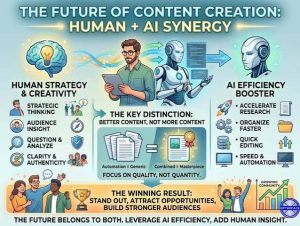
The Future of AI in content creation
AI is likely to become even more integrated into everyday content workflows.
Creators may increasingly use AI for research assistance, brainstorming, editing, personalization, video production, design, translation, and content adaptation.
As AI tools become more capable, the difference between AI-assisted and traditional content creation may become less noticeable.
At the same time, human originality may become even more valuable.
When basic content can be produced quickly, audiences may pay more attention to unique experiences, strong opinions, authentic stories, useful expertise, and content that feels genuinely created for them.
The future of content creation is therefore unlikely to be simply “AI versus humans.” It is more likely to be a combination of technology and human creativity, with each contributing something different.
Conclusion
Artificial Intelligence is changing content creation by making many parts of the process faster and more accessible. From brainstorming blog ideas and writing drafts to creating visuals, developing video scripts, personalizing communication, and repurposing existing content, AI can support creators in many different ways.
However, AI should not be viewed as a complete replacement for human creativity. It can generate information and suggestions, but humans provide direction, experience, judgment, originality, and emotional understanding.
The most effective approach is to use AI as a creative assistant rather than allowing it to completely control the content process. AI can help save time and reduce repetitive work, while humans can focus on making the final content accurate, meaningful, engaging, and relevant.
As technology continues to develop, content creation will continue to evolve. The creators who learn how to use AI responsibly while maintaining their own voice and creativity will be better prepared for the changing digital environment.
Frequently Asked Questions
1. What is AI content creation?
AI content creation is the use of artificial intelligence tools to assist in producing content such as blogs, social media posts, images, videos, scripts, emails, and product descriptions.
2. Can AI completely replace content creators?
AI can automate and assist with many content-related tasks, but human creativity, experience, judgment, storytelling, and originality remain important for producing meaningful content.
3. How can AI help in blog writing?
AI can help with topic ideas, outlines, headlines, first drafts, rewriting, summarization, and content organization. Human review is still important for accuracy, originality, and quality.
4. Can AI create social media content?
Yes. AI can assist with captions, post ideas, hooks, content calendars, scripts, and different versions of social media content.
5. What are the main disadvantages of using AI for content creation?
Some challenges include inaccurate information, repetitive or generic writing, privacy concerns, originality issues, and the need for human fact-checking and editing.
6. What is the future of AI in content creation?
AI is expected to become a larger part of content workflows, helping with writing, design, video, personalization, editing, and content repurposing. Human creativity and strategic decision-making will continue to play an important role.