
In today’s digital world, people often search online before deciding whether they want to trust a business. A potential customer may look at a company’s website, read reviews, check social media, search for customer experiences, or simply type the brand name into a search engine. Within a few minutes, they can form an opinion about a business without ever speaking directly to it.
This is why Online Reputation Management, commonly known as ORM, has become an important part of digital marketing.
Online reputation is not created by a single advertisement or one social media post. It develops through many digital interactions over time. Customer reviews, comments, social media mentions, search results, news articles, discussions, and even the way a business responds to criticism can influence how people perceive a brand. ORM focuses on monitoring these conversations and taking responsible steps to maintain a trustworthy and positive online presence.
What Is Online Reputation Management?
Online Reputation Management is the process of monitoring, managing, and improving how a business, brand, product, or individual is perceived across the internet.
It involves paying attention to what people are saying online and understanding what a new customer is likely to see when searching for the brand.
ORM can include monitoring reviews, responding to customer feedback, managing social media conversations, keeping business information accurate, addressing misleading information, and creating useful content that represents the brand clearly.
It is important to understand that reputation management is not about hiding every negative comment. Genuine criticism can provide useful information about customer experiences. A responsible ORM strategy focuses on understanding the issue, responding appropriately, and improving the underlying customer experience when necessary.
Why Online Reputation Matters
Imagine that someone discovers a business for the first time. They like the product or service, but before making a decision, they search the company’s name online.
They find an active website, useful information, recent customer reviews, and professional responses from the business. This creates one type of impression.
Now imagine a different situation. The website contains outdated information, unanswered customer complaints, inconsistent details, and several unresolved issues.
Even if the business itself provides a good product, the online information may create uncertainty.
This is why online reputation can influence the customer journey. Reviews and online conversations are often part of the research process people go through before deciding whether to interact with a business.
Where Does an Online Reputation Exist?
A brand’s reputation is not limited to its official website.
People can discuss a business in many different places, including search engines, social media platforms, review websites, forums, blogs, news websites, and business listings.
Search results are particularly important because they can bring together information from several different sources. A person searching for a company may see the official website alongside reviews, social profiles, articles, videos, or other public information.
This means a business should think about its complete digital presence rather than focusing on only one platform.
Monitoring Is the First Step
A business cannot manage its reputation effectively if it does not know what people are saying about it.
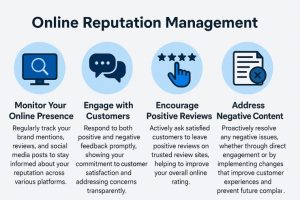
Monitoring means regularly checking brand mentions, customer reviews, comments, messages, and relevant conversations.
For a small business, this might begin with regularly searching the brand name and checking important review and social channels. Larger businesses may use reputation-monitoring or social-listening tools to organize mentions across multiple platforms.
The purpose of monitoring is not to react emotionally to every comment. Instead, it helps the business identify patterns.
For example, if several customers mention the same problem, that may indicate an issue that needs to be addressed at the business level.
Monitoring can also help a company notice positive feedback and understand what customers appreciate about its products or services.
Managing Customer Reviews
Customer reviews are one of the most visible parts of online reputation management.
Positive reviews can give potential customers additional confidence, while negative reviews can raise questions about a business.
However, receiving a negative review does not automatically mean that a business has a bad reputation.
What matters is how the business handles feedback.
A professional response can acknowledge the customer’s concern, provide clarification when appropriate, and invite further discussion through a suitable channel.
A defensive or aggressive response can make a small issue appear much larger.
Businesses should also avoid creating fake reviews or manipulating customer feedback. A trustworthy reputation should be built through genuine customer experiences rather than artificial praise.
How to Respond to Negative Feedback
Negative feedback can be uncomfortable, but ignoring it does not necessarily make it disappear.
A thoughtful response usually starts by understanding what the customer is actually saying.
If the business made a mistake, acknowledging the problem and explaining the next step can be more useful than making excuses.
If the complaint is based on incorrect information, the business can calmly provide clarification without attacking the person.
Sometimes a public conversation becomes too complicated for a comment section. In such cases, it may be more appropriate to continue the discussion privately while still giving a brief public response that shows the concern has been acknowledged.
The goal should be resolution and communication, not winning an argument.
Social Media and Online Reputation
Social media has made brand communication much more immediate.
Customers can comment on posts, mention brands, send messages, or share their experiences with their followers.
A single interaction can sometimes reach a much larger audience than the original customer expected.
This makes social media management an important part of ORM.
Businesses should monitor relevant mentions and respond in a consistent, professional tone. They should also understand that every public response can become part of the brand’s digital identity.
A calm and helpful communication style can contribute to a more professional online presence.
The Role of Content in Reputation Management
Online reputation management is not only about responding to negative information.
Businesses can also proactively create useful content that clearly communicates who they are and what they offer.
This could include educational blog posts, helpful guides, company updates, service information, customer stories, videos, or other relevant resources.
Useful content gives people more accurate information to discover when researching the business.
A strong content strategy can therefore support reputation management by helping a brand communicate its expertise and provide context around its products or services.
Keeping Business Information Accurate
Inconsistent information can create unnecessary confusion.
A business should make sure important details such as its name, contact information, website information, services, and other public details are kept accurate wherever possible.
Imagine a customer finds one phone number on one platform and a different number somewhere else. Even a simple inconsistency can make the business appear less reliable.
Regularly reviewing important digital profiles can help reduce these problems.
Consistency does not mean every platform must look exactly the same. It means the important facts about the business should remain clear and accurate.
ORM and Customer Experience
One of the most important ideas in reputation management is that reputation cannot be fixed only through communication.
If customers repeatedly complain about the same genuine problem, changing the wording of responses will not solve the underlying issue.
For example, if customers consistently report difficulties with delivery, customer support, or product quality, the business should examine the actual process.
ORM can therefore provide useful feedback for improving the customer experience.
In this sense, negative feedback can become a source of information. Instead of simply trying to make criticism disappear, a business can look for recurring problems and use that information to improve.
ORM and Digital Marketing
Online Reputation Management is closely connected with other areas of digital marketing.
Social media helps businesses communicate with their audiences. Content marketing helps them provide useful information. Paid advertising brings visibility to products and services. A professional website provides an official place where people can learn about the business.
All of these activities can influence how people perceive a brand.
For example, a company may run a successful advertising campaign, but a potential customer may still search for reviews before making a purchase.
This shows why reputation should not be treated as a separate activity that only becomes important during a crisis.
It should be considered part of the broader digital marketing strategy.
Building a Proactive Reputation Strategy
A proactive approach means working on reputation before a major problem appears.
Businesses can regularly monitor mentions, review customer feedback, maintain accurate profiles, publish useful content, and create clear communication guidelines.
It is also useful to decide who is responsible for responding to public feedback.
Having a basic response process can prevent confusion when an unexpected complaint appears.
A reputation strategy should also include clear goals. Depending on the business, these might include improving customer communication, increasing genuine reviews, reducing repeated complaints, improving response times, or maintaining accurate online information.
Regular measurement helps businesses understand whether their efforts are actually making a difference.
Common ORM Mistakes
One major mistake is ignoring negative feedback completely.
Another is responding emotionally. A business representative may feel personally attacked by criticism, but a public response should remain professional.
Deleting genuine criticism simply because it is negative is also not a sustainable reputation strategy.
Businesses should distinguish between genuine criticism and content that violates a platform’s policies. When content is genuinely fraudulent, abusive, or otherwise against platform rules, the appropriate process is to report it through the platform rather than trying to manipulate public discussion.
Another mistake is focusing only on positive reviews.
A healthy reputation strategy pays attention to the complete picture: what customers like, what they dislike, what problems repeatedly appear, and what the business can improve.
The Future of Online Reputation Management
Online reputation management will continue to evolve as people use more digital platforms to research businesses.
Search engines, social media, review platforms, online communities, and AI-powered information systems are all becoming part of the way people discover and evaluate brands.
This means businesses will need to pay attention not only to what they publish themselves but also to the broader information ecosystem surrounding their brand.
Technology can make monitoring easier, but technology alone cannot create a trustworthy reputation.
A business still needs good products or services, responsible communication, customer care, and a willingness to learn from feedback.
The strongest reputation is ultimately supported by real experiences.
Conclusion
Online Reputation Management is an important part of modern digital marketing because a brand’s online presence can strongly influence how potential customers understand and evaluate it.
ORM involves much more than responding to negative reviews. It includes monitoring online conversations, managing customer feedback, keeping information accurate, communicating professionally, creating useful content, and paying attention to the overall customer experience.
A strong reputation cannot be built overnight. It develops through consistent actions and genuine interactions over time.
Businesses should therefore treat ORM as an ongoing process rather than an emergency solution. Instead of trying to hide every negative comment, they can use feedback to understand customer concerns, improve their services, and communicate more effectively.
In the digital world, people are constantly forming opinions based on what they see online. A business that listens carefully, responds responsibly, provides real value, and continuously improves its customer experience can build an online reputation that supports long-term trust and growth.
Frequently Asked Questions
1. What is Online Reputation Management?
Online Reputation Management is the process of monitoring, managing, and improving how a business or brand is perceived across websites, search results, social media, review platforms, and other online channels.
2. Why is Online Reputation Management important?
ORM is important because potential customers often research a business online before deciding whether to interact with or purchase from it. Reviews, public conversations, and search results can influence that first impression.
3. Does ORM mean removing negative reviews?
No. ORM is not simply about removing negative information. Genuine criticism can provide useful feedback. A responsible strategy focuses on understanding concerns, responding professionally, and improving genuine problems.
4. How should a business respond to a negative review?
A business should understand the complaint, remain calm and professional, acknowledge genuine concerns, provide appropriate clarification, and work toward a reasonable resolution when possible.
5. Can social media affect a brand’s online reputation?
Yes. Social media comments, mentions, posts, messages, and shared experiences can influence how people perceive a business. This is why social listening and professional communication are useful parts of ORM.
6. Is Online Reputation Management a one-time activity?
No. Reputation management is an ongoing process. Businesses need to continue monitoring their online presence, responding to feedback, maintaining accurate information, and improving the customer experience.